Note
Positive vs negative cropmarks: what's the difference?
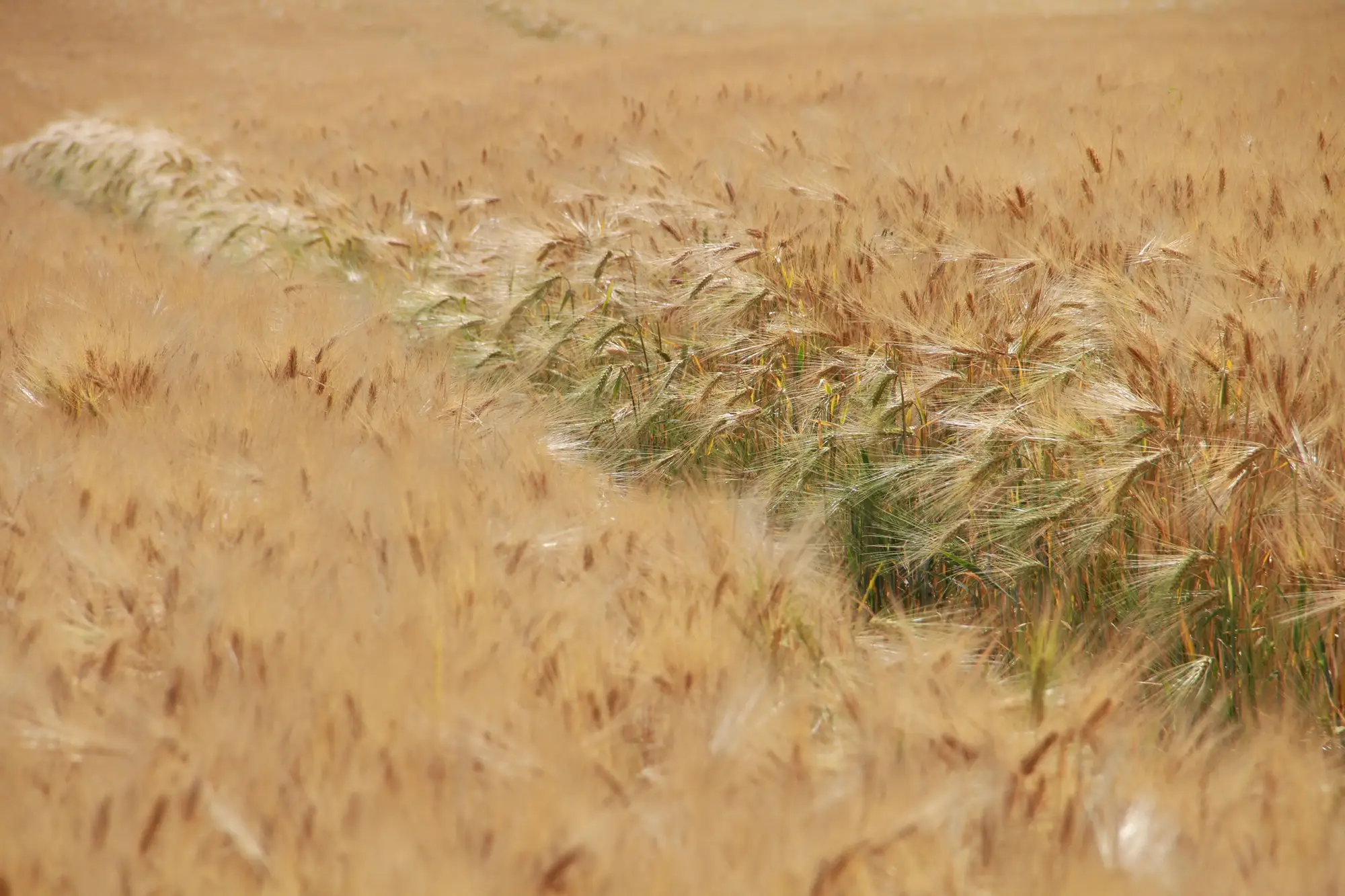
Cropmarks are differential growth or stress in a crop caused by what's sitting underneath it. Positive and negative are the two basic flavors, and knowing which one you're looking at tells you something about what's in the ground before anyone puts a trowel in.
Positive cropmarks: buried cuts holding moisture
A positive cropmark shows up where a crop grows taller, greener or ripens later than the plants around it. The cause is usually a ditch, pit or other cut feature backfilled with looser, deeper soil that holds water and nutrients longer than the surrounding subsoil. Roots reach further down into that softer fill, and in a dry spell the crop sitting over a buried ditch stays green while the rest of the field is already turning. On a stubble field after harvest, positive marks often read as darker, denser lines, the best-growing crop tracing the line of the cut.
Negative cropmarks: buried masonry starving the roots
A negative cropmark is the opposite stress. It shows up where a crop grows shorter, paler or ripens earlier, because something solid and shallow under the topsoil is restricting root depth and moisture. Buried walls, metalled surfaces, rubble spreads and robber trenches tend to produce negative marks. The stone or compacted material gives roots less soil to work with, so the crop over a wall foundation stresses first in a dry summer and shows as a pale strip against greener crop either side.
Positive marks trace voids: ditches, pits, palaeochannels. Negative marks trace solids: walls, roads, rubble spreads. Reading an aerial photo or an NIR pass without knowing which is which means mistaking a robbed-out wall for a ditch, or the other way round, and that gets the interpretation backwards before the DBA even gets written.
Why the polarity call matters for a desk-based assessment
Getting this right changes how you characterize a site before anyone walks the field. A rectilinear positive mark reads as an enclosure ditch or a palaeochannel meander. The same rectilinear shape as a negative mark reads as a building platform or a robbed wall footing, and that's two different narratives for the same assessment, two different sets of expectations going into evaluation trenching, and a different conversation with the curator about mitigation.
Both types depend on moisture stress to show up at all, which is why cropmark visibility tracks the weather so closely. A wet summer flattens both signals. Everything has enough water, nothing stresses, nothing shows. A dry one brings both out, often within the same few weeks, which is also why units end up watching forecasts instead of getting on with the rest of the desk-based work.
Working from this season's marks, not the archive copy
Most desk-based assessments still lean on historic APs and HER cropmark records, which means the polarity call is often made from a scan of a decades-old photo taken in someone else's dry summer. That's workable, but it leaves a field director guessing whether this year's conditions will throw up anything new, or whether the one good cropmark summer on record already got everything there is to get.
Buried Feature Detection runs NIR imagery over a survey area through the growing season and returns the resulting cropmark layer as a georeferenced map, so the read is on this year's growth stress rather than whatever dry summer the archive happened to catch.
Worth a look before the next DBA goes out the door.